Mahogany is one of the most searched terms we deal with in this business. Homeowners in Buckhead, Sandy Springs, and Alpharetta call us specifically because they have a mahogany door and they want someone who understands how to work with it. The second question after “can you do it” is almost always “what does it cost.”
This post gives you real numbers — not ranges so wide they’re useless. It covers what drives the price up or down on mahogany specifically, how refinishing cost compares to replacement cost on a quality hardwood door, what the process actually involves, and why cutting corners on mahogany refinishing costs more in the long run than doing it right the first time.
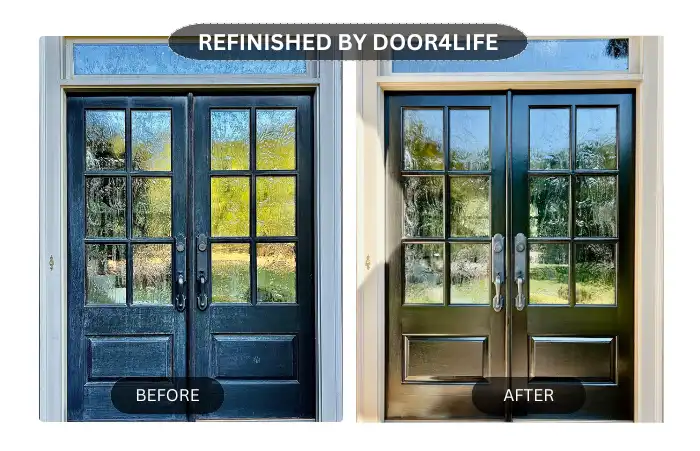
After 13 years refinishing wood doors across Metro Atlanta, I’ve seen every variation of this job. A standard mahogany front door in average condition through a straightforward refinish. Grand double mahogany entries with sidelights and transoms on Buckhead estates. Mahogany doors that were painted over by a previous owner and needed chemical stripping before we could even assess the wood underneath. The price range is real — and the factors that move it are predictable once you understand what the work actually involves.
Why Mahogany Is Different From Other Door Wood Species
Before getting to cost, it helps to understand why mahogany commands a different approach than pine or fir doors.
Mahogany is a dense, tight-grained hardwood. It absorbs stain evenly — which means the color result is more predictable and more consistent than on softer woods. It’s naturally resistant to moisture and rot, which is why it’s been the preferred material for high-end entry doors for over a century. When properly finished and maintained, a solid mahogany door outlasts the house it’s on.
The challenge with mahogany refinishing is that the wood’s quality raises the stakes. A mediocre refinishing job on a pine door looks mediocre. A mediocre refinishing job on a mahogany door looks like someone wasted an expensive piece of wood. The grain is fine enough and the color depth potential is high enough that poor surface preparation and low-quality finish are immediately obvious. This is why experienced mahogany refinishing requires more care — and why it costs more than standard door refinishing when done right.
Mahogany also has a natural reddish-pink undertone that affects every stain color applied over it. Warm tones work with the wood’s character. Cool-toned or gray stains fight it. Getting a color result that looks intentional on mahogany requires understanding this upfront, not figuring it out after the stain is on.
What Mahogany Door Refinishing Actually Costs in Atlanta
Real numbers from jobs across Metro Atlanta. These are not manufacturer estimates or national averages — they’re what homeowners in this market pay for professional on-site refinishing.
| Door Type | Condition | Refinishing Cost | Notes |
|---|---|---|---|
| Standard single mahogany door | Good — finish worn but wood sound | $350–$500 | Full strip, stain, two coats UV varnish |
| Standard single mahogany door | Fair — surface checking, minor soft spots | $450–$650 | Includes wood repair before finishing |
| Grand single mahogany door (oversized) | Good | $500–$750 | Extra labor for size and panel count |
| Double mahogany entry doors | Good | $700–$1,100 | Two full doors, matched color application |
| Double mahogany entry with sidelights | Good | $900–$1,400 | Sidelights add significant time |
| Mahogany door painted over | Any | Add $150–$300 | Chemical stripping required before assessment |
| Custom color matching required | Good | Add $75–$150 | On-site mixing and test patches |
These figures assume professional-grade materials — specifically marine-grade UV varnish rather than standard exterior polyurethane. The material cost difference between the two is real, and it shows in how long the finish holds up in Atlanta’s climate.
What Drives the Price Up — And What Doesn’t
Door Size and Panel Complexity
A flat-panel mahogany door takes less time than a raised-panel door with routed detail, which takes less time than an arched door with decorative glass inserts. Labor on door refinishing is primarily time-based, and complex panel configurations take significantly more time to strip, sand, and finish properly than flat surfaces. An oversized mahogany door — 8 feet tall rather than the standard 6’8″ — adds surface area that adds time across every step of the process.
Current Condition of the Wood
A mahogany door in good condition — finish worn and faded but wood firm and sound throughout — is a straightforward job. The old finish comes off, the wood is prepped, and the new finish goes on. A door with surface checking, soft spots, or localized rot requires wood repair work before refinishing. That repair work is priced separately from the refinishing itself, and the extent of it isn’t fully known until the old finish is stripped and the wood is assessed properly.
This is why any honest quote for a damaged door comes in two parts: the refinishing cost and the repair cost pending assessment. Anyone who gives you a single fixed price for a damaged mahogany door before stripping it is guessing.
Sidelights and Transoms
Sidelights — the narrow vertical glass panels on either side of a door — and transoms above the door are separate items that need to be matched to the main door stain color. They add time and material cost. Matching the color across the main door and sidelights consistently requires careful work, particularly on mahogany where the grain pattern and stain absorption can vary between individual pieces of wood even from the same species.
Whether It’s Been Painted
A mahogany door that has been painted over — which happens more often than you’d think, usually by a previous owner who didn’t understand what the door was — requires chemical stripping before the wood can even be assessed. Paint doesn’t come off with the same process as varnish or stain. Chemical stripping is slower and adds cost. On a painted mahogany door, the refinishing quote can’t be finalized until the paint is off and the wood condition is known.
What Doesn’t Drive the Price Up
The neighborhood doesn’t change the price. A mahogany door in Sandy Springs costs the same to refinish as the same door in Decatur. Some companies charge more in affluent neighborhoods — we don’t. The door is the door. What you’re paying for is the work on the wood, not the zip code.
What the Refinishing Process Actually Involves on Mahogany
Understanding what you’re paying for makes the cost easier to evaluate. Here’s what a professional mahogany door refinishing job covers from start to finish.
Removal and Entry Seal
The door comes off the hinges. All hardware — knobs, deadbolts, knockers, kick plates — comes off. Your entrance is sealed before we start work so the home stays secure and conditioned air doesn’t escape while the door is out. On a ground-floor entry, this matters practically. We don’t leave an open doorway.
Full Strip to Bare Wood
The existing finish comes off completely. On mahogany, this means stripping back to bare wood — not sanding over the existing finish and recoating. Refinishing over an existing finish traps any moisture already in the wood and prevents the new stain from bonding to the wood fiber directly. It also means the new finish is only as sound as the old finish underneath, which is already failing.
This step takes time. Chemical strippers loosen the old finish. Careful hand sanding removes what the stripper lifts. On a detail-heavy mahogany door with routed panel edges and carved elements, stripping properly takes longer than on a flat door. This is where some companies cut corners — applying new finish over old rather than starting clean. The result looks acceptable for a few months and then starts peeling from underneath.
Wood Assessment and Repair
Once the door is stripped to bare wood, the condition is fully visible for the first time. Surface checking, soft spots, and any areas where moisture has penetrated the wood are identified at this stage. Minor issues are addressed before staining — wood hardener for soft spots, epoxy filler for cracks or missing material. On a sound mahogany door in good condition, this step is quick. On a door that’s been neglected for years, it can be substantial.
Surface Preparation
Triple sanding in progressive grits. Mahogany requires fine grit finishing to close the surface properly before stain — the tight grain of the wood benefits from thorough preparation in a way that coarser-grained woods don’t. This step determines how evenly the stain absorbs and how smooth the final finish looks.
Stain Application
Stain goes on in stages. Mahogany absorbs evenly, which makes color consistency achievable — but it still requires controlled application to prevent lap marks at panel edges and uneven color across the door face. On custom color work, we test on a small area of the actual door before committing to the full surface. The test patch dries, is assessed in natural light, and adjusted before proceeding.
UV Marine Varnish
Two coats of marine-grade UV varnish. On mahogany, we use a finish rated for Atlanta’s UV intensity and humidity specifically — not standard exterior polyurethane. The marine-grade product stays flexible as the wood expands and contracts through Atlanta’s temperature swings, which is why it doesn’t crack or peel the way standard varnish does within the first few years. Between coats, light sanding ensures adhesion and removes any dust nibs from the surface.
Reinstall and Inspection
The door goes back on the same day in most cases. Hardware is reinstalled, the fit and swing are checked, and the finish is inspected in natural light before we leave. On a mahogany door, natural light assessment matters — the depth of the grain and the richness of the stain color reads differently indoors under artificial light than it does in daylight.
Mahogany Door Refinishing vs. Replacement — The Real Cost Comparison
This is where the math matters most for homeowners making a practical decision.
| Refinishing | Replacement | |
|---|---|---|
| Standard single mahogany door | $350–$650 | $1,500–$4,000 installed |
| Grand single mahogany door | $500–$750 | $3,000–$6,000 installed |
| Double mahogany entry | $700–$1,100 | $5,000–$12,000 installed |
| Timeline | Same day | 2–6 weeks (order + installation) |
| Wood quality | Original wood preserved | Modern replacement may be inferior |
| Disruption | Sealed entry, door back same day | Open entry during installation |
The cost difference is significant on its own. But there’s a less-discussed factor that matters on older Atlanta homes in particular: the mahogany in doors from the 1970s through 1990s is often higher quality than what’s readily available as replacement stock today. Older mahogany doors were made from genuinely old-growth wood — denser, tighter-grained, and more durable than much of the farmed mahogany available now. Replacing an original mahogany door with a modern one isn’t a straight substitution in terms of material quality.
Refinishing preserves the original wood. A door that’s refinished properly and maintained with a check every 3 years can outlast any modern replacement at a fraction of the ongoing cost.
When Refinishing Isn’t the Right Answer
This is an honest section. Not every mahogany door should be refinished.
If the core of the door is fully rotted through — not just surface rot in isolated sections, but structural compromise across the door panel — refinishing addresses the surface without fixing the underlying problem. A door like this needs replacing.
If the door is structurally unsound — warped badly enough that it no longer seals properly against the frame, or if the joints have separated to the point where the door is in multiple pieces held together by the skin — refinishing is cosmetic work on a door that needs to be replaced.
If the mahogany is genuine veneer over a hollow or composite core that has failed — which is different from solid mahogany — the repair options are more limited.
In every case, we assess the door honestly before quoting a refinishing job. If it’s not worth refinishing, we tell the homeowner directly rather than taking the job and delivering a result that won’t hold.
Why Mahogany Refinishing in Atlanta Requires Climate-Specific Materials
Standard exterior varnish sold at hardware stores is formulated for average conditions. Atlanta’s combination of UV intensity, humidity, and temperature variation is not average. A standard polyurethane varnish on a south-facing mahogany door in Atlanta will show UV degradation — fading, micro-cracking, chalking — within 18 to 30 months depending on exposure.
Marine-grade UV varnish is formulated for environments significantly harsher than Atlanta — boats, docks, and coastal structures exposed to salt, direct sun, and constant moisture. Applied to a mahogany door, it performs at a different level because the challenge it was designed for exceeds what Atlanta’s climate throws at it.
This is why the finish choice matters as much as the application quality. The best stain job in the world won’t hold up in Atlanta sun if the varnish over it isn’t rated for the exposure.
Frequently Asked Questions
How do I know if my door is solid mahogany or mahogany veneer?
Press a fingernail firmly into the wood at the bottom edge — the end grain. Solid mahogany has consistent grain running through the depth of the door. Veneer over a composite core will show a thin wood layer over a different material underneath. You can also knock on the door in the center panel — solid wood produces a dull thud; hollow or composite cores produce a noticeably hollow sound.
Can you refinish a mahogany door that’s been neglected for years?
Yes, in most cases. Heavy weathering, deep surface checking, and significant UV fading are all addressable through the stripping and repair process. The question isn’t whether the surface looks bad — it’s whether the core wood is still structurally sound. Text us a photo and we’ll give you an honest assessment before anyone comes out.
How long will the refinishing last on my mahogany door in Atlanta?
With marine-grade UV varnish on a properly prepared surface, a south or west-facing mahogany door in Atlanta holds up well for 5–7 years before needing a full redo. A maintenance coat at year 3–4 — light sanding of worn areas and a fresh varnish layer — can extend that significantly. North or east-facing doors in similar conditions regularly go 8–10 years.
Do you match existing mahogany stain color or can I change it?
Both. If you want to match the existing color, we work from the stripped bare wood and mix to replicate the original tone. If you want a different color — lighter, darker, or a completely different shade — we discuss the options given your specific mahogany and test on-site before committing to the full door.
Can you refinish mahogany doors in Buckhead, Sandy Springs, and Alpharetta?
Yes. These neighborhoods represent a significant portion of our mahogany refinishing work across Metro Atlanta. HOA color guidelines in Sandy Springs and Alpharetta are something we’re familiar with — if you have specific requirements, tell us before we start.
What happens if you find damage after stripping the door?
We assess the damage and discuss it with you before proceeding. Minor surface issues — small soft spots, hairline cracks — are included in the scope of a standard refinishing job. Significant structural damage or extensive rot is quoted separately as repair work, and you decide whether to proceed before we touch it.