The decision looks simple from the outside. A wood door on a commercial property looks rough — faded, weathered, finish peeling — and the property manager has two options: refinish it or replace it. Most people assume replacement is the professional choice. Most people are wrong.
After 13 years working on wood doors across Metro Atlanta, the commercial calls we get fall into two categories. The first is a business owner who called us first, got a realistic picture of the cost and process, and made an informed decision. The second is a business owner who got a door replacement quote, experienced the disruption and the bill, and is now calling us for the other two doors on the property.
This post covers the real cost comparison, what refinishing actually involves on a commercial property, how we work around business hours, which types of businesses benefit most, and how long a commercial refinish holds up under daily use. By the end, a property manager or business owner should have everything they need to make this decision without calling three contractors for quotes they can’t evaluate.
The First Impression Problem Most Atlanta Businesses Underestimate
Before getting to cost, there’s a business case for door appearance that goes beyond aesthetics.
A customer approaching a restaurant, office, or retail space forms an impression before they open the door. Research on customer behavior consistently shows that exterior condition — including the entrance — affects perceived quality and trustworthiness of the business inside. A faded, weathered wood door on an otherwise well-maintained commercial property sends a specific message: either the business doesn’t notice, or it doesn’t care.
In Atlanta’s competitive restaurant market — particularly in Buckhead, Midtown, and Virginia-Highland — this matters more than most owners acknowledge. A fine dining restaurant with a weather-beaten entrance is working against its own positioning before a guest steps inside. A law office or financial services firm with peeling finish on the entry door is undermining the professional image it spends money projecting everywhere else.
The cost of refinishing one commercial door is less than the cost of one lost client meeting, one negative review specifically mentioning the entrance, or one day of reduced foot traffic. This is the business case for maintenance that most property managers never articulate but every customer experiences.
What Commercial Door Replacement Actually Costs in Atlanta
Real numbers, because this is where the decision usually gets made.
A standard commercial wood door replacement in Atlanta — supply, installation, new hardware — runs $2,000–$5,000 per door for a quality solid wood replacement. For a grand entry, double door configuration, or custom wood door on a high-end commercial property, the range is $5,000–$12,000+ per opening. These figures assume the frame is sound. If the frame needs work, add more.
Beyond the material and labor cost, commercial door replacement involves:
Ordering lead time. Custom wood doors typically run 3–8 weeks from order to delivery. Standard commercial doors are faster but still 1–2 weeks. During that time, the property is operating with whatever is currently on the door.
Installation disruption. Commercial door installation is not a quiet, clean process. The old door comes out, the new door goes in, the frame may need adjustment, hardware is installed. On a primary entrance, this typically takes half a day to a full day — during which that entrance is either closed or open with no door.
Permit considerations. Some commercial door replacements in Atlanta require permits, particularly in historic districts or properties with specific zoning requirements. Add time and cost.
For a multi-door commercial property — a restaurant with a main entrance and a secondary entrance, an office building with lobby doors and conference room entry doors — the replacement cost multiplies per opening.
What Commercial Door Refinishing Costs — And What It Includes
| Door Type | Refinishing Cost | Notes |
|---|---|---|
| Standard single commercial door | $400–$650 | Full strip, stain, marine UV varnish |
| Oversized or detail-heavy entry | $600–$900 | Extra labor for size and panel complexity |
| Double commercial entry doors | $750–$1,200 | Two doors, matched color |
| Double entry with sidelights | $1,000–$1,600 | Sidelights matched to main doors |
| Multi-door property (per door) | $350–$550 | Volume efficiency when multiple doors done together |
| Emergency / same-day scheduling | Add $100–$200 | Priority scheduling outside normal queue |
These figures include professional-grade materials — specifically marine-grade UV varnish rather than standard exterior finish. On a commercial property where doors take daily punishment from foot traffic, hardware use, and Atlanta’s sun, finish quality determines how long the job holds up before needing attention again.
Compared to replacement, refinishing a commercial door costs roughly 15–25% of what a quality wood door replacement costs on the same opening. For a property manager with a maintenance budget and multiple doors, this difference is the entire conversation.
The Business Hours Problem — And How We Solve It
The practical objection most commercial clients raise isn’t cost. It’s disruption. A restaurant can’t close for a day while its entrance is being refinished. An office building can’t have its lobby doors off their hinges during business hours. A retail space needs its entrance operational when customers arrive.
This is a logistics problem, not a technical one — and it’s entirely solvable.
Early Morning Starts
Most commercial refinishing work in Atlanta starts between 6:00 and 7:00 AM. A restaurant that opens at 11:00 AM has a four to five hour window before the first customer arrives. A standard single commercial door refinished start to finish — stripped, prepped, stained, sealed, reinstalled — takes three to five hours depending on condition and complexity. For most restaurants and retail spaces, the door is back on its hinges before the first employee arrives for the morning shift.
After-Hours Work
For properties that open early or run continuous operations, we schedule after close. A bar or restaurant that closes at midnight has a window from closing until morning staff arrives. Offices with late evening cleaning crews have a similar window. The door comes down after the last customer or employee leaves, the work is completed, and the door is reinstalled before opening the next morning.
[H3] Phased Multi-Door Work
For properties with multiple entrance points — a restaurant with a main street entrance and a patio entrance, an office building with a lobby door and a secondary door — we phase the work so at least one entrance remains operational at all times. We don’t take both doors off simultaneously. Main entrance goes first while secondary remains open, then the secondary is done while the main entrance is back in service.
What Doesn’t Work
Refinishing can’t be completed while a door is actively being used. The finish needs time to cure between coats, and traffic through a door during that window damages the wet finish. We schedule around this — it’s not a limitation of refinishing specifically, it’s a limitation of any finish application. A freshly painted or varnished surface needs undisturbed curing time regardless of who applied it.
How Long a Commercial Refinish Holds Up Under Daily Use
This is a legitimate concern. A residential front door might get opened and closed 10–20 times a day. A busy restaurant entrance sees 200–500 openings on a good Saturday. The mechanical wear on the finish is genuinely different.
The honest answer is that commercial doors need more frequent attention than residential ones — not because the refinishing is done differently, but because the use is categorically heavier.
| Property Type | Expected Refinish Interval | Notes |
|---|---|---|
| Low-traffic office (side entrance) | 5–7 years | Comparable to residential |
| Standard office lobby door | 3–5 years | Moderate daily use |
| High-traffic restaurant entrance | 2–4 years | Heavy daily use, UV exposure |
| Bar or nightclub entrance | 2–3 years | Heaviest use category |
| Multi-unit residential lobby | 3–5 years | Constant use, lower UV |
Marine-grade UV varnish extends these intervals compared to standard commercial finishes because it stays flexible under repeated mechanical stress — the opening and closing cycles — rather than becoming brittle and cracking at wear points. The areas that show wear first on commercial doors are the push and pull points, the bottom of the door where foot contact happens, and the edges around the lock hardware. A maintenance coat on these specific areas can extend the full refinish interval significantly.
A commercial door maintenance program — annual inspection, targeted maintenance coat on wear areas — costs far less than recurring full refinishes and keeps the door looking professionally finished year-round.
Which Atlanta Businesses Benefit Most From Commercial Door Refinishing
Not every commercial property has wood doors worth refinishing. Here’s where the investment makes the most sense.
Restaurants and Hospitality
Atlanta’s restaurant scene is concentrated in neighborhoods where the exterior presentation matters to the positioning — Buckhead, Midtown, Virginia-Highland, Inman Park, Ponce City Market area. Restaurants in these neighborhoods typically have solid wood entry doors as part of the design intent of the space. Refinishing preserves that design intent. Replacing with a cheaper door undermines it.
Fine dining establishments benefit most from a maintained, properly finished wood entrance because the entrance is part of the experience the restaurant is selling before a guest enters. Casual dining benefits from the cost efficiency — the refinish cost is a fraction of what a replacement would run, and the result is indistinguishable to a customer.
Professional Services Offices
Law firms, financial advisors, medical offices, and similar professional services businesses in Atlanta’s commercial districts and suburban office parks have specific appearance expectations. A weathered entrance works against the professional positioning these businesses maintain in every other aspect of their client-facing presentation.
For these businesses, the calculation is straightforward: the cost of one refinishing job is less than the cost of one client’s changed perception based on a neglected entrance.
Boutique Retail
High-end retail in Atlanta — particularly in Buckhead and Ponce City Market — invests heavily in the visual environment of the store. The entrance is the first element of that environment a customer encounters. Boutique retailers with solid wood doors that have been allowed to weather are working against their own merchandising investment.
Multi-Unit Residential Properties
Apartment buildings and condominium complexes with wood lobby doors see constant use and face the same UV and humidity challenges as any Atlanta commercial property. For property managers, a refinishing program across multiple lobby and common area doors is significantly more cost-effective than replacement — and the appearance impact on tenant satisfaction and property value is real.
Historic Properties
Atlanta has significant historic commercial districts — Sweet Auburn, Inman Park commercial corridor, parts of Decatur. Properties in these areas often have original wood doors that are architecturally significant. Replacement with a modern door on a historic commercial property raises preservation questions beyond just cost. Refinishing preserves the original material while restoring its appearance and protection.
What the Commercial Refinishing Process Looks Like On-Site
Understanding what actually happens during a commercial refinishing job helps property managers plan around it.
Pre-Job Assessment
Before scheduling, we assess the door condition — either in person or from photos — to identify any repair work needed and confirm the scheduling approach that works for the property’s operating hours. A door with localized rot or structural damage needs repair work before refinishing, and that changes the timeline.
Door Removal and Entry Security
The door comes off its hinges. On a commercial property, the opening is secured immediately — we don’t leave a commercial entrance open and unmonitored. The security of the opening is managed from the moment the door comes down to the moment it goes back up.
Stripping
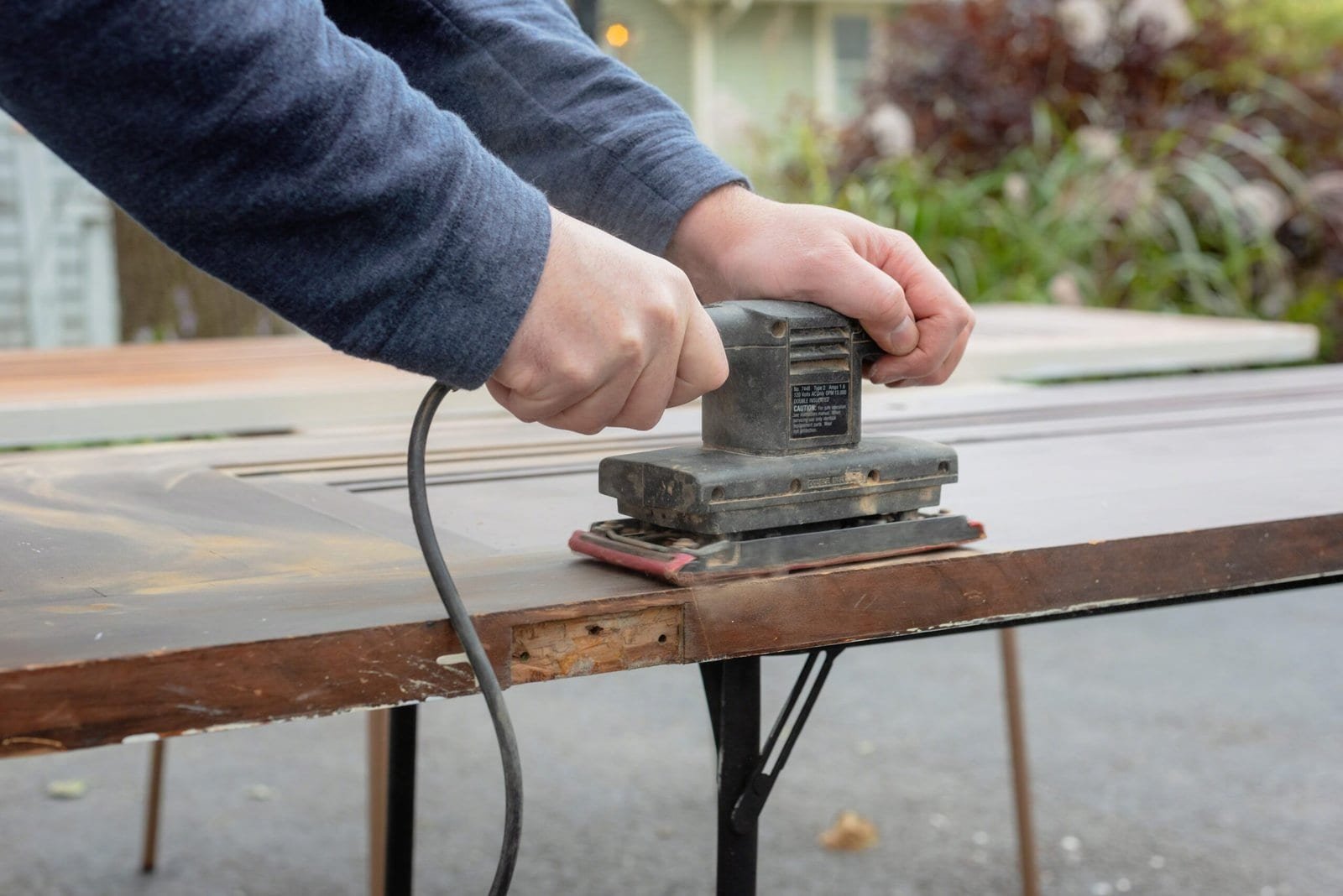
The old finish comes off completely. On commercial doors that have been refinished or repainted multiple times, this means stripping through multiple layers. Layered-over finishes on commercial doors are common — each previous refinishing job that went over the existing finish rather than stripping it adds to the accumulation. We go back to bare wood regardless of what’s there.
Repair Assessment and Work
Once stripped, the wood condition is fully visible. High-traffic commercial doors show specific wear patterns — the push and pull areas, the bottom rail, around hardware cutouts. Minor damage is addressed before staining. Significant structural issues are discussed with the property manager before we proceed.
Stain and Finish
Stain is applied to the existing color or a new color if the property is rebranding or the owner wants a change. On commercial properties with multiple doors, color matching across all doors is standard — inconsistent color across a property’s entrances reads as neglect rather than design.
Marine-grade UV varnish goes on in two coats with proper cure time between. On a commercial door in heavy use, we apply a slightly heavier build than on a residential door — the additional finish thickness provides more material to withstand mechanical wear before the wood is exposed.
Reinstall and Sign-Off
The door goes back on before the property opens. Hardware is reinstalled. We do a final fit check, swing check, and finish inspection before leaving. For commercial clients, we provide a written confirmation of the work completed and the finish applied — useful for maintenance records.
The Case for a Commercial Door Maintenance Program
One refinishing job is a repair. A maintenance program is a strategy.
For commercial properties with wood doors, a structured maintenance approach — annual inspection, targeted maintenance coats on wear areas every 1–2 years, full refinish on a 3–5 year cycle depending on traffic — keeps the entrance looking professionally maintained at all times while significantly reducing the cost per year of door maintenance compared to reactive refinishing when the finish fails.
The math on a busy Atlanta restaurant entrance: a full refinish every 3 years at $600 per door is $200 per year. A maintenance coat every 18 months that extends the full refinish cycle to 5 years reduces that further. Compared to a replacement at $3,000–$5,000 that may still need refinishing within a few years if a standard finish is used — the structured maintenance approach is the clear financial choice over a 10-year horizon.
For property managers with multiple wood doors across a commercial property or portfolio, we can assess the full inventory and develop a maintenance schedule that keeps every door at a professionally maintained standard without requiring reactive decisions when individual doors deteriorate.
Frequently Asked Questions
Can you work around a restaurant’s operating hours without closing the entrance?
Yes. We schedule commercial jobs specifically around operating hours — typically early morning before opening or after last service. Most single-door jobs are completed within 3–5 hours. For properties that operate continuously, we discuss the schedule in advance and identify the lowest-traffic window. The door is back on before customers arrive.
Can you match the existing stain color across multiple doors on our property?
Yes. Color matching across multiple doors on a property is standard for commercial jobs. We mix to match on-site and test before committing to the full application. Consistent color across all of a property’s wood doors is part of what makes a commercial property look professionally maintained rather than patched together.
How do you handle a commercial door that’s been painted over?
Chemical stripping is required to remove paint from a wood door before it can be stained. This adds time and cost compared to a door with a varnish or stain finish. It’s necessary — stain applied over paint produces an uneven, unprofessional result. If the door has been painted, we identify this during assessment and factor it into the quote.
Is there a minimum number of doors for a commercial job?
No. We work on single commercial doors as readily as multi-door properties. For larger properties with multiple doors, we can assess the full inventory in one visit and develop a phased schedule.
Do you service commercial properties in Buckhead, Midtown, and Decatur?
Yes. We cover all of Metro Atlanta for commercial work — Buckhead, Midtown, Decatur, Virginia-Highland, Sandy Springs, Alpharetta, Marietta, and surrounding areas.
What if our door needs repair work as well as refinishing?
We assess the door condition before quoting. If repair work — wood rot treatment, structural epoxy, hardware cutout repair — is needed, it’s quoted separately and discussed before we proceed. You decide whether to proceed with the full scope before any work starts.